24,000 New Rental Units Are Reshaping Vancouver's Multi-Family Market — What Fraser Valley Investors Should Know
A major correction is underway in Vancouver's multi-family (apartment building) sector, and it's a story worth understanding whether you own rental property, are thinking about investing, or simply want a clearer read on where the Lower Mainland market is heading. A wave of new supply is colliding with softer demand — and the ripple effects reach directly into the Fraser Valley.
The Headline: A Wave of New Supply
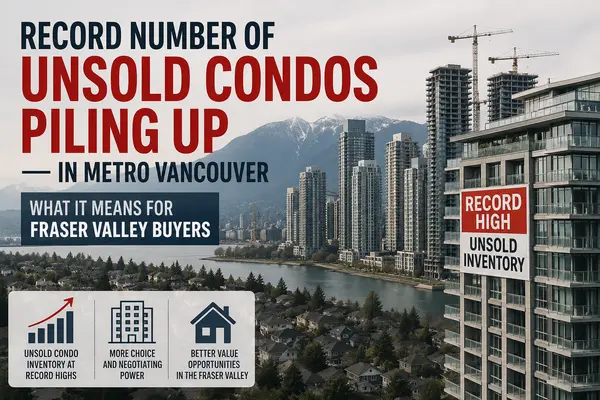
Nearly 24,000 rental units are expected to be delivered across the Vancouver region over the next two years, according to commercial real estate firm Cushman & Wakefield. That's a significant amount of new inventory hitting the market in a short window.
Record construction completions in 2025, combined with high deliveries in 2026, are pushing down rent growth and creating tenant-friendly conditions. For renters, that's welcome relief after years of near-zero vacancy. For investors and building owners, it means more competition and pressure on rents.
The firm expects it could take several years to absorb the existing inventory, with meaningful rent growth unlikely to resume until 2028 — at which point longer-term supply constraints could re-emerge if development slows and immigration picks back up.
Why Is This Happening?
The correction comes down to a supply-demand mismatch. Supply has outpaced demand for several quarters, pushing vacancy up and rents down — particularly for brand-new rental product.
David Venance, executive vice-president with Cushman & Wakefield, framed it as a return to normal rather than a collapse. "This is a cyclical normalization after an overheated period, it's not a structural weakening," he said. Importantly, he noted that demand hasn't disappeared — it just hasn't kept pace with supply.
The demand side has been hit by population changes. Canada's population has declined due to fewer temporary workers and international students, contributing to a repricing of rental apartment buildings. Greg Ambrose, vice-president with Colliers Canada, pointed to a drop in B.C.'s population of over 41,000 people in 2025 as part of the demand-side pressure.
Which Buildings Are Most Affected?
Not all rental properties are feeling this equally. Brand-new rental apartment buildings that were underwritten during the pandemic and are completing now are the most exposed to declining rents, compared to mid-level or legacy buildings built decades ago. Those newer buildings were financed on rent assumptions that today's softer market may not support.
That's creating real financial pressure for some owners. Declining asset values are pushing some sellers toward near-100-per-cent loan-to-value positions, which is prompting developers to use more incentives to fill units and support building valuations.
A Buyer's Market for Investors
Here's the part that matters most if you're looking at rental property as an investment. For investors, it's now a buyer's market in an asset class that has traditionally favoured sellers, according to Ambrose. Rising listings of apartment buildings are giving investors more options and forcing sellers to compete on price, said Carey Buntain, principal with Avison Young.
Who's doing the buying? Demand is being driven primarily by private, local investors — about 70 per cent of transactions involve legacy apartment operators looking to expand their portfolios when they see good value. Institutional buyers have been very selective, while non-profit demand is waning due to tighter public funding.
The Fraser Valley Angle
This is where it gets directly relevant to our market. Buntain identified suburbs like Langley and Coquitlam as growth areas with long-term promise, thanks to infrastructure, rapid transit expansion, and abundant land. In other words, as investors look beyond the core of Vancouver, the Fraser Valley and its surrounding communities are squarely on the radar.
There's also a note of caution worth understanding for anyone chasing yield in our area. Buntain observed that outside of Metro Vancouver, buyers are seeking a little more yield to compensate for the greater risk of softer rents and lower immigration in secondary markets. Translation: investors expect a somewhat higher return in Fraser Valley and other suburban markets precisely because those markets carry a bit more risk in a softer rental environment.
The Contrarian Opportunity
The most interesting insight from the experts is a forward-looking one. With housing starts down significantly, fewer new projects being started today may mean reduced supply in the near future. Ambrose put it plainly: "I suspect 24 months from now, we could be surprised by how quickly the rental market may tighten up with reduced supply and potentially new government policy around population growth."
That's the classic real estate cycle at work. Today's oversupply and soft rents are pushing developers to stop building — which sets up the conditions for the next tightening. Investors who buy well during a buyer's market, when there's less competition and more room to negotiate, are the ones positioned to benefit when the cycle turns.
What This Means for You
If you're a rental property investor, the current environment offers negotiating leverage that hasn't existed in this asset class for years — more listings, motivated sellers, and pricing that favours buyers. The key is buying assets that make sense on today's rents, not on optimistic future projections. Growth suburbs like Langley are drawing investor attention for good reason.
If you're a renter in the Fraser Valley, softer conditions and rising vacancy region-wide generally mean more choice and less upward pressure on rents than in recent years.
If you're a homeowner or seller, this multi-family correction is part of the same broader story we've been tracking all year: elevated supply, softer demand tied to population shifts, and a market that currently favours buyers across most segments.
Thinking about buying, selling, or investing in Fraser Valley real estate — residential or a rental property? Reach out and I'm happy to walk through what current conditions mean for your specific goals.
Categories
Recent Posts