Is the BC Condo Conversion Plan a Bailout? Federal Housing Minister Says No — Here's Where Things Stand
The debate over the federal-provincial plan to buy unsold condos in BC and convert them into affordable housing isn't going away — it's getting louder. On July 8, Federal Housing Minister Gregor Robertson pushed back firmly against the bailout label, while a separate political fight was playing out in Ottawa over whether the ethics committee should be investigating the program at all. Here's a clear breakdown of what's happening and what it means for the Fraser Valley housing market.
What Robertson Said
Speaking at the Adanac Housing Co-op in Vancouver on July 8, Robertson said the characterization of the program as a developer bailout is simply misinformation. The BC government is leading the program, he emphasized, with the federal government contributing roughly 10 per cent of the total cost — contingent on the full program details being finalized.
Robertson described the condo conversion plan as a straightforward opportunity to acquire empty homes below market value and make them available through a rent-to-own program — faster and cheaper than building new housing from scratch. "If it wasn't a good, affordable opportunity, there's no reason why B.C. or the federal government would be investing in that as a solution for more affordable housing," he said.
When asked whether he was surprised by the public backlash, Robertson's answer was pointed: he said he hasn't heard a broad public outcry — only a Conservative political one — and that media coverage amplifying the bailout narrative is doing so without the program details yet in hand. "Nobody has seen what this program will be," he said.
The Ethics Committee Fight
The political backdrop to Robertson's comments is significant. On July 7, Liberal MPs on the House of Commons ethics committee voted to shut down a Conservative attempt to have the committee investigate the program — specifically, who lobbied for it and who benefits. Robertson said he submitted a letter to the committee clarifying the federal government's limited role in the program.
Conservative MP Aaron Gunn told media he was frustrated by the move: "What we were hoping for was to actually get answers to important questions that Canadians have about this billionaire condo bailout." Conservative MP Jacob Mantle argued the government should let condo prices fall to market-clearing levels and let developers absorb their own losses, rather than using taxpayer dollars to remove units from a market that's already correcting.
The Liberals' position is that the ethics probe was premature — there are no program details yet to investigate. Robertson's letter to the committee made the same point: it's too early to judge a program that hasn't been fully designed.
Why There Are Still Unanswered Questions
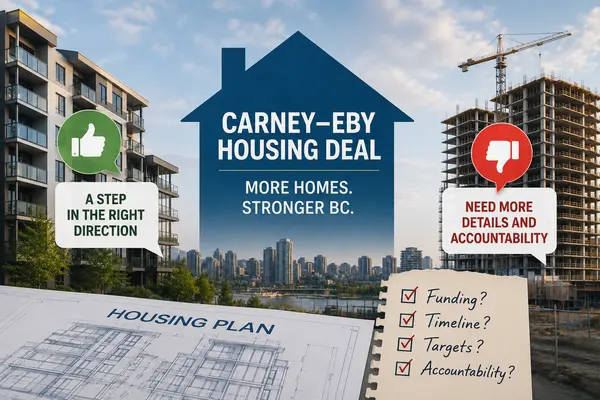
The honest reality is that the controversy has been fuelled, at least in part, by a communications stumble. The plan was announced on June 18 — when Prime Minister Carney was in Vancouver for Team Canada's FIFA World Cup match — before the financing structure, purchase prices, eligible municipalities, or unit criteria were finalized. Both Carney and Eby have since acknowledged the rollout could have been handled better.
What we do know: the program targets distressed condo assets, potentially including projects in or near foreclosure. Units in the City of Vancouver are explicitly excluded because the economics don't work there. Eby has said repeatedly that no developer will profit — purchases will happen below the cost of construction. Build Canada Homes and BC Housing would be the acquiring entities.
What remains unknown: the exact price the government will pay per unit, which buildings or municipalities will be targeted, how affordability will be defined, and how the rent-to-own model will be structured.
What This Means for the Fraser Valley
As we covered in our earlier post on the Carney-Eby announcement, the Fraser Valley is explicitly one of the regions where Eby has said the economics of this program work. The program targets renters who can afford monthly payments but can't accumulate a down payment — a demographic that is very present in communities like Langley, Abbotsford, Surrey, and Mission.
If the program moves forward as described — purchasing distressed inventory below market and converting it to rent-to-own — it could open a new pathway to homeownership for a group of buyers who are currently priced out despite earning reasonable incomes. That's a meaningful development for this market.
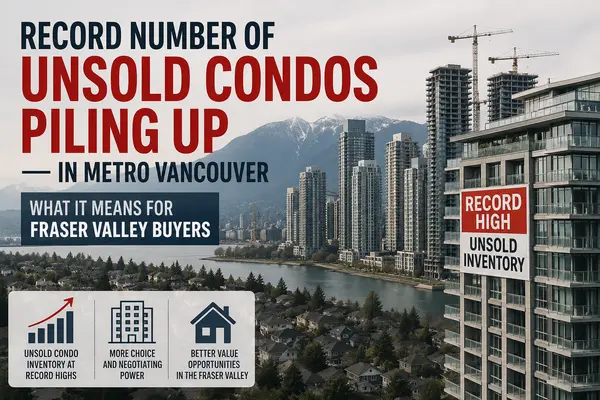
If it stalls politically or gets significantly restructured, the status quo continues: elevated inventory, soft demand, and a buyer's market that's been in place all spring and into summer.
The next major signal to watch is when the BC government actually releases the program framework — that's when this debate shifts from politics to practicality.
In the meantime, current market conditions in the Fraser Valley remain strongly buyer-friendly, with benchmark prices down 7 per cent year-over-year and over 10,000 active listings across the region. If you have questions about what any of this means for a purchase or sale you're considering, reach out — I'm happy to walk through it with you.
Categories
Recent Posts